

Developed by Chris with AI assistance from Kay.
I have reached the stage of digital organisation where I can confidently tell you that I have the information. I just cannot tell you which account has it, which application contains it, or whether the thing I remember agreeing to happened in an email, a meeting or a conversation with an AI that now appears to have changed its name.
Somewhere, I am extremely well organised.
I’m a full-time CEO, an entrepreneur, a husband, a father and a grandfather. I’m also president of the board of the Juno Beach Centre Association, a community responsibility substantial enough to be a job on its own. Add investments and side projects, and it gets complicated. These are not intrusions into my life. They are my life. I chose them.
What I did not choose was a second career moving information between them.
There are roughly five inboxes across Gmail, Microsoft 365 and Outlook. Calendars, Slack, Granola meeting notes, documents and text messages. Then come the AI tools, each remarkably capable, each needing an explanation of who I am and what on earth we are doing. I estimate hundreds of messages a day. Frankly, building the dashboard is somewhere in the messages.
Built out of a little desperation
Kay is the personal AI chief of staff I’m building. Consider this a thoroughly biased introduction to something I desperately want to use. The name takes inspiration from Kay Summersby, Eisenhower’s wartime driver and secretary, and her spirit of dependable service.
I want one conversation with an assistant that can draw on the context I choose to make available. Not another inbox. Not a more attractively coloured place to discover that I am behind.
Switching is what wears me down. Work to community to family logistics. Open the message. Remember the background. Find the document. Discover the other document. Remember why I opened the first message.
I want to ask, “What actually needs me today?” and get something better than everything that arrived most recently.
The conversation is the interface
I use these tools through conversation almost exclusively. I speak to a persistent ChatGPT assistant, a dot I call Kay. Wispr Flow makes dictation into other applications easy too. That removes the keyboard, but it is not the whole idea.
The more compelling interface is a two-way conversation. I speak, the assistant answers aloud, and I ask a follow-up: “Why do you think that?” “What have we missed?” Not just a microphone replacing my thumbs, but a conversation that carries the context forward.
Even this project grew out of spoken instructions and revisions. A separate agent and production workflow made the film overnight. Now I’m refining the article by talking to my phone on the trip to the airport and at the gate, without opening a laptop and appointing myself the production department.
Three parts of a life
Personal. Community. Work. They all matter, but they do not demand attention equally. Work has deadlines and a considerable talent for making itself heard. Health, family and relationships may not arrive with a red notification badge. Community deserves more than whatever is left.
I do not want to become more efficient at stealing time from one part of my life to subsidise another.
I want Kay to help me notice when one part is disappearing from the plan. Pair that with Eisenhower’s urgency-and-importance approach: what matters, what needs attention now, and what can be scheduled, delegated or stopped? Ask those questions across the whole life. A personal commitment should not lose automatically because a work email arrived in capital letters.
I remain capable of making my own poor scheduling decisions. I would simply appreciate better evidence before making them.
Where the context lives
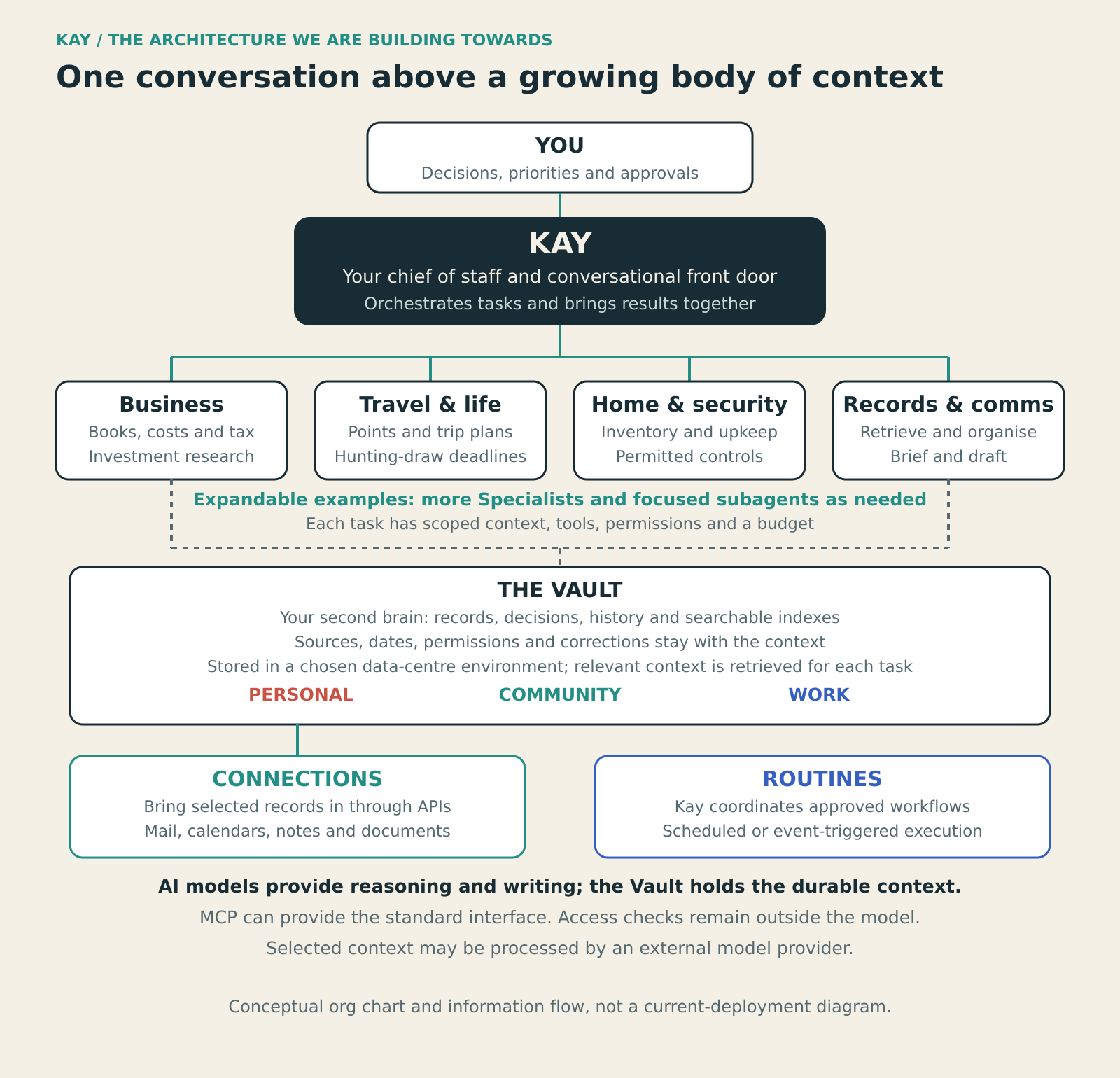
The useful technical idea is straightforward: intelligence and memory do not have to live in the same place. The AI model reasons and writes. In the architecture I’m building towards, the conversation connects to a controlled store of records and context, with an index to find what matters. I want to change the model without starting my life story again from Chapter One.
We’re giving the parts simple names. Kay is the chief of staff. The Vault is my personal information vault, or second brain, holding the durable context. Connections are approved links to information sources. Specialists are focused agents. Routines are repeatable automations.
Think of the Vault as a private records room on a virtual server in a professionally operated data centre. Virtualisation lets software behave like its own computer without a physical machine under my desk. It is the same broad cloud foundation used for websites and business applications, not a special AI cupboard. The design lets us choose where the Vault lives, with Canadian data-centre hosting part of the plan.
Connections use a service’s application programming interface, or API, to retrieve permitted mail, calendar events, meeting notes and documents. The original accounts remain where they are. The design preserves each record’s source and date, and explicitly enforces access rules when storing, retrieving and sharing it, including summaries derived from it. Keyword and semantic search, which finds material by meaning, help locate them; large originals can be linked rather than repeatedly copied.
When I ask a question, the system retrieves relevant permitted material and supplies it to the model. That is retrieval-augmented generation, or RAG. My translation: please read the file before offering an opinion. Instead of expecting a chatbot to remember everything, the context has a home and the answer can point back to evidence.
From knowing more to getting things done
The point is not to collect more agents. It is to turn something I notice into useful work without personally joining every dot.
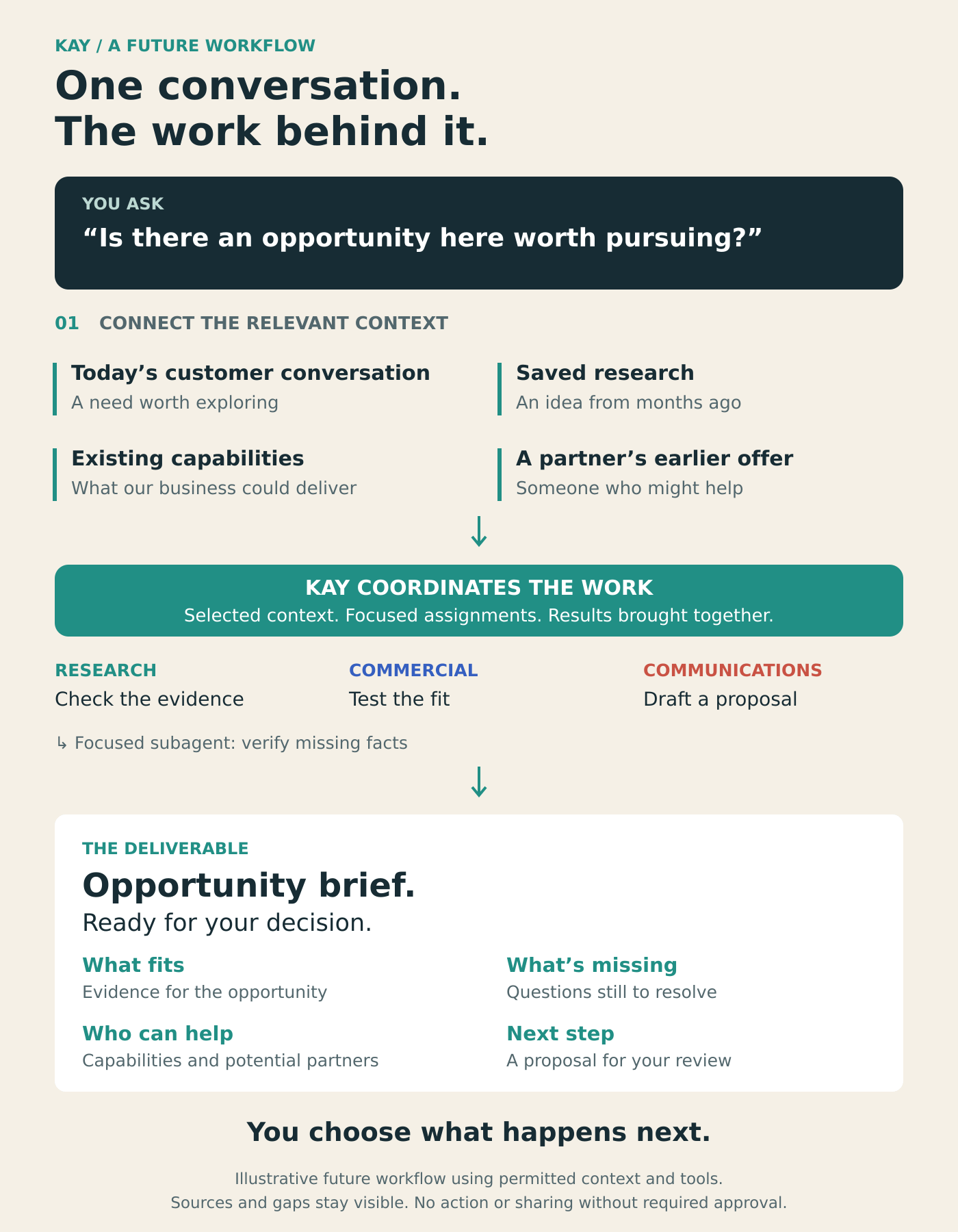
A customer makes a passing comment in a meeting. Kay could connect it with research I saved months ago, a capability inside our business and an earlier offer from a potential partner. I ask, “Is there an opportunity here worth pursuing?” A research Specialist checks the evidence. A commercial Specialist tests the fit. A communications Specialist drafts a proposal. What comes back is an opportunity brief: why it might work, what is missing, who could help and a sensible next step. Not a confident leap from a casual remark to a new business, but a promising connection made concrete enough to judge.
Or a routine renewal email arrives. Instead of becoming another thing to remember, it could be checked against the original contract, recent invoices and actual usage. Has the price changed? Are we paying twice for overlapping services? When is the notice deadline? The result could be a comparison and a drafted supplier question for my review, not an automatic cancellation or a promise of savings.
The same approach could assemble travel options around family commitments, organise an accountant-ready file across separately controlled businesses, or connect a home-maintenance issue with its warranty and service history.
A Specialist is software using an AI model, instructions and defined tools for a task. Kay’s orchestration divides the work, brings results together and can delegate narrower questions to focused subagents. The team expands to fit the job, within its permissions, tools and budget. Routines handle the repeatable steps; standard APIs and interfaces such as MCP let other software contribute capabilities through approved Connections.
The design requires each task to receive only the context it is allowed to use. Consequential actions still need approval, logs, limits and a way to stop. This is the architecture we are building towards: not more departments to manage, but fewer loose ends that only I can join together.
Meetings should leave more than a recording
On a day with three to five meetings, decisions, responsibilities and changing priorities live in conversation. By meeting five, remembering precisely what happened in meeting two can become a competitive sport.
With appropriate consent and permission, software can capture a meeting and expose its transcript through an API. Granola’s API, for example, provides access to notes and transcripts on eligible plans and within approved access scopes. A Connection could bring these into the Vault with dates, participants and sources. Specialists could then identify decisions, actions, owners, deadlines and unresolved questions for review.
Those records could update project context behind the scenes. Changed deadlines could flag plans for review. Tone or priority inferred from a conversation should be an interpretation to check, not a fact quietly invented. Agreed actions must remain distinguishable from suggestions, with the original transcript available.
Then I can ask, “What did we decide across the last four meetings? What changed? What have I promised that still needs doing?” Kay could connect those conversations with the emails and documents around them, while I get on with the next one.
Two examples that would make a difference
Imagine I’m at the farm, our happy place, walking the dogs with Lisa. I tell my phone: “Prepare me for the board meeting. Review the minutes from the last five meetings, pull out decisions and outstanding commitments, and help assemble the next board packet.” Preparation should not require an archaeological expedition through five inboxes.
With authorised access, a records Specialist could retrieve the minutes, a planning Specialist compare commitments with later emails, and a communications Specialist assemble a draft with source links, changed deadlines and questions to resolve. I review it, confirm what is current and decide what can be shared. Meanwhile, I can put the phone away and get back to the walk.
Or an important email arrives while I’m travelling. Kay flags why it matters. I speak a five-second instruction: “Check the history, research the options and make me a one-page PDF for the meeting.” Specialists could retrieve the background, check external evidence and prepare the brief for review. The same approach could produce proposals, presentations or creative drafts. The instruction is short because the background is available, not because a five-second request promises a five-second report.
With the right permitted sources, I would also like to ask my available bank balance or when my driver’s licence and NEXUS card expire, and get timely reminders with source records attached. A confident guess is not much help at the airport.
A second brain that grows with me
A project can accumulate decisions, commitments, documents and outcomes. Kay could connect today’s request with last month’s decision, or recognise that two apparently unrelated conversations concern the same opportunity. Each useful, well-maintained record makes the next one easier to understand.
But a growing archive is not automatically a growing truth. Plans change, records go stale and sources disagree. Corrections must carry through; summaries need a route back to originals. Sometimes the answer should be, “I found two versions. Which one governs?”
I prefer that to an assistant preserving a misunderstanding for the rest of my life. I can do that myself.
Built as reusable software
Own the context. Rent the intelligence.
I’m building towards software another person could configure with their own authorised accounts, chosen agents and model services, permissions and Routines. Their context and boundaries would be their own, not a collection of arrangements that only work on my computer.
The durable foundation, or substrate, is the records, indexes, permissions and workflows. Intelligence can be rented from whichever providers suit the job. As models improve, I want to replace that layer without rebuilding my history.
Readable, exportable records, documented interfaces and replaceable connectors reduce dependence on any one supplier. Software still needs maintenance, compatibility checks and security updates. But we need not build the whole house around this year’s favourite appliance.
Why I think this can be managed safely
Established cloud infrastructure offers encryption, identity controls, restricted networks, backups and monitoring. That is a foundation, not a guarantee. The application still needs proper configuration, testing and recovery plans.
Connections should get the smallest permissions needed, protect credentials and allow access to be revoked. Read-only limits changes, but reading private information remains a significant permission. MCP, the Model Context Protocol, gives AI applications a standard interface for tools and context. Access checks must still be enforced outside the model, not left to the assistant’s good manners.
The other boundaries matter too: server administration, what Specialists can retrieve, what Routines can do and which model provider receives context. An incoming document could contain instructions designed to mislead an agent. It is evidence to assess, not a new boss.
The Vault’s location and the model’s processing location are separate choices. Selected context may leave the Vault for an external provider, so the design must control what is sent and under which terms. Limited permissions, traceable sources, action logs and tested boundaries are the reassurance I want. “Trust us, it’s AI” is not a security policy I plan to frame.
A way to ask me without interrupting me
I also want to explore a virtual Chris that colleagues, project teams and fellow Juno Beach Centre volunteers could talk to. They could discuss a decision’s background, explore an idea or prepare their next step using knowledge I had chosen to make available. The ambition is access around the clock without requiring the actual Chris around the clock. Lisa may be the strongest supporter of that feature.
Each audience would get a chosen view of the Vault, not a spare key to my life. The assistant should distinguish “Chris said this” from “Here is a suggestion based on his records,” and bring new decisions or commitments back to me. I want to make my context available, not appoint a second CEO who has never met the first one.
Why I’m excited anyway
Work-life balance does not come in a download. But spending less time reconstructing context and more time making decisions, keeping promises and being present could change what is possible.
And this reaches beyond the people I work with today. I imagine my children and grandchildren talking to my virtual self: “Grandpa, why did you start that business?” “What would you do if you were me?” “What did you learn the hard way?” Spoken replies and follow-up questions, not a search through a family archive. Chosen history, recordings of my voice and authorised images could, with careful design, make that conversation recognisably mine: sound, tone, manner, humour and cultural perspective.
I would want it grounded in my actual words and records, admitting a missing answer rather than inventing a memory. A conversational record of my thinking, not a complete replica or literally me inside a computer. Readable formats, ongoing care and chosen family access could preserve it across generations, without automatically passing on private business material or other people’s information. An AI-powered virtual great-grandfather, talking with generations I may never meet. That moves me as much as the productivity does.
I cannot predict what these tools will be capable of in twenty years. But I want them to have something meaningful to work with: the context of a life well lived.
My goal is to leave behind an absurdly large context file. Ideally, because I’ve lived a very long life and had plenty worth putting in it.

Kay is not supposed to help me squeeze another working day into the evening.
She is supposed to help me remember why I wanted the evening in the first place.
If you had a chief of staff for your whole life, what is the first thing you would ask them to take off your plate?
Three places to explore further
Building a Second Brain: Tiago Forte’s accessible guide to capturing, organising and reusing knowledge.
Context engineering for AI agents: Anthropic explains how agents select useful records, tools and history rather than putting everything into every prompt.
Connect meeting notes to an AI assistant: Granola’s practical guide to bringing permitted meeting context into ChatGPT and other tools.
Technical references
Virtualisation: how software-defined computing resources work on physical infrastructure.
Retrieval-augmented generation: the research behind retrieving relevant records to help generate an answer.
MCP architecture: the interface connecting AI applications with tools and context.
Restricted account access: the OAuth security guidance behind limiting permissions.
Layered cloud security: the Canadian Centre for Cyber Security’s explanation of defence in depth.
Agent and connector risks: OWASP’s guidance on protecting tool and context connections.